


Shutdown, Collapse & Dissociation

Shutdown, Collapse & Dissociation
Not every stress response looks anxious, angry or visibly overwhelmed. Sometimes the system becomes quieter — heavy, distant, numb, slowed down or disconnected.
Sometimes protection looks like less.
Less movement. Less emotion. Less speech. Less connection to what is happening around you.
People sometimes describe these experiences as feeling blank, far away, frozen, exhausted, unreal or disconnected from themselves or their surroundings.
Dissociation is a broad term for experiences involving disconnection between aspects of awareness, memory, identity, emotion, perception or sense of self. :contentReference[oaicite:1]{index=1}

Shutdown, collapse and dissociation are not identical experiences.
These words are often used loosely. The aim here is to help you notice differences without diagnosing yourself.
“I cannot do any more.”
Shutdown can feel like withdrawal, reduced speech, difficulty thinking, needing less stimulation or becoming unable to keep responding to demands.
- Wanting to retreat
- Difficulty making decisions
- Reduced communication
- Feeling mentally slowed
- Needing the world to become smaller
“I have nothing left.”
Collapse may be experienced as profound depletion, heaviness, reduced motivation or feeling unable to mobilise physically or emotionally.
- Feeling physically heavy
- Very low energy
- Wanting to lie down or disappear from demands
- Difficulty initiating simple tasks
- Feeling depleted after prolonged strain
“I do not feel fully here.”
Dissociative experiences can include feeling disconnected from yourself or the world, feeling detached from emotions, or experiencing gaps in memory. :contentReference[oaicite:2]{index=2}
- Feeling unreal or dreamlike
- Feeling detached from yourself
- Feeling emotionally numb
- The environment seeming distant or unreal
- Not remembering parts of an experience
“Doing nothing” can hide a lot of internal effort.
Someone may be sitting still while trying to process too much information, manage intense emotion, reconnect with their body or simply find enough capacity to complete the next action.
What feels closest to your experience right now?
Choose anything that fits. This is a reflection tool, not a diagnostic test.
Your suggestions will appear here.
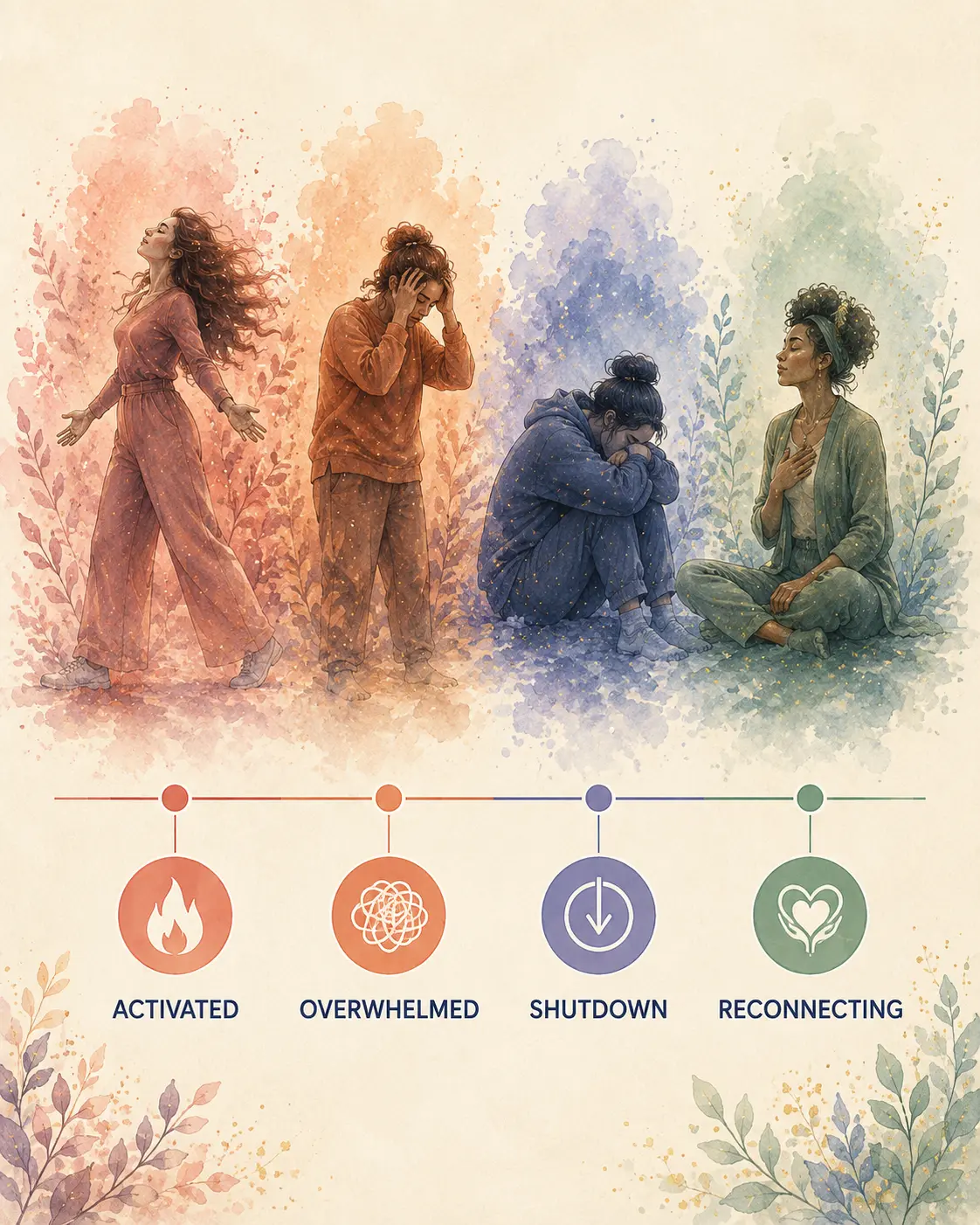
Sometimes the system shifts from “too much” to “less.”
The path is not identical for everyone, but noticing the transition earlier may help you respond before you are completely depleted.
Activation
Restlessness, urgency, tension, worry or emotional intensity.
Overwhelm
Too much information, emotion, stimulation or demand.
Shutdown
Reduced response, withdrawal, blankness or collapse.
Reconnection
Gradual return of orientation, energy, sensation and choice.
Shutdown usually does not need more pressure.
Reduce demand
Pause non-essential decisions, conversations or tasks where possible.
Reduce stimulation
Lower noise, screens, bright light or social input if these feel overwhelming.
Orient gently
Look around and notice where you are, rather than forcing deep internal attention.
Use physical contact points
Feel a chair, floor, blanket or familiar object if that feels comfortable.
Use tiny actions
One sip of water, one movement or one simple decision can be enough.
Add safe connection
A trusted person can sometimes help provide orientation and gentle support.
Grounding can help some people reconnect with the present.
Grounding approaches commonly involve directing attention toward current sensory information — for example sounds, textures, physical contact or surroundings. :contentReference[oaicite:3]{index=3}
Name three things you can see.
Notice the chair, floor or an object in your hand.
Identify sounds near you and farther away.
Remind yourself where you are and what day it is.
More intensity is not always the answer.
Do not demand instant explanation
Words and insight may be harder to access in the moment.
Do not pile on decisions
Reduce the number of choices if thinking already feels difficult.
Do not force emotional intensity
Trying to make yourself “feel something” may increase overwhelm.
Do not assume it is laziness
Look at capacity, health, stress and context before making that judgement.
Repeated or disruptive dissociation deserves appropriate support.
Consider speaking with a qualified health or mental-health professional if experiences of disconnection, memory loss, depersonalisation, derealisation or shutdown are frequent, distressing, difficult to manage or interfering with daily life. Dissociative disorders are recognised mental-health conditions and can be assessed and treated professionally. :contentReference[oaicite:4]{index=4}
You do not need to diagnose yourself before asking for help.
Follow what you noticed.
Coming back can happen slowly.
Look for a little more orientation, connection or choice — not an instant return to normal.