


Stress in the Body

Stress in the Body
Stress is not only something you think about. Your body may also respond through tension, breathing, digestion, sleep, energy and physical sensations.
Sometimes your body notices the load before your mind does.
You may tell yourself that you are coping while your jaw is tight, your shoulders are lifted, your stomach is unsettled or sleep has become harder.
Stress can affect people physically as well as emotionally. Commonly reported physical signs include headaches, muscle tension or pain, stomach problems, changes in heartbeat and sleep disturbance. :contentReference[oaicite:1]{index=1}
These sensations are not a diagnosis. They are signals worth noticing alongside the rest of what is happening.
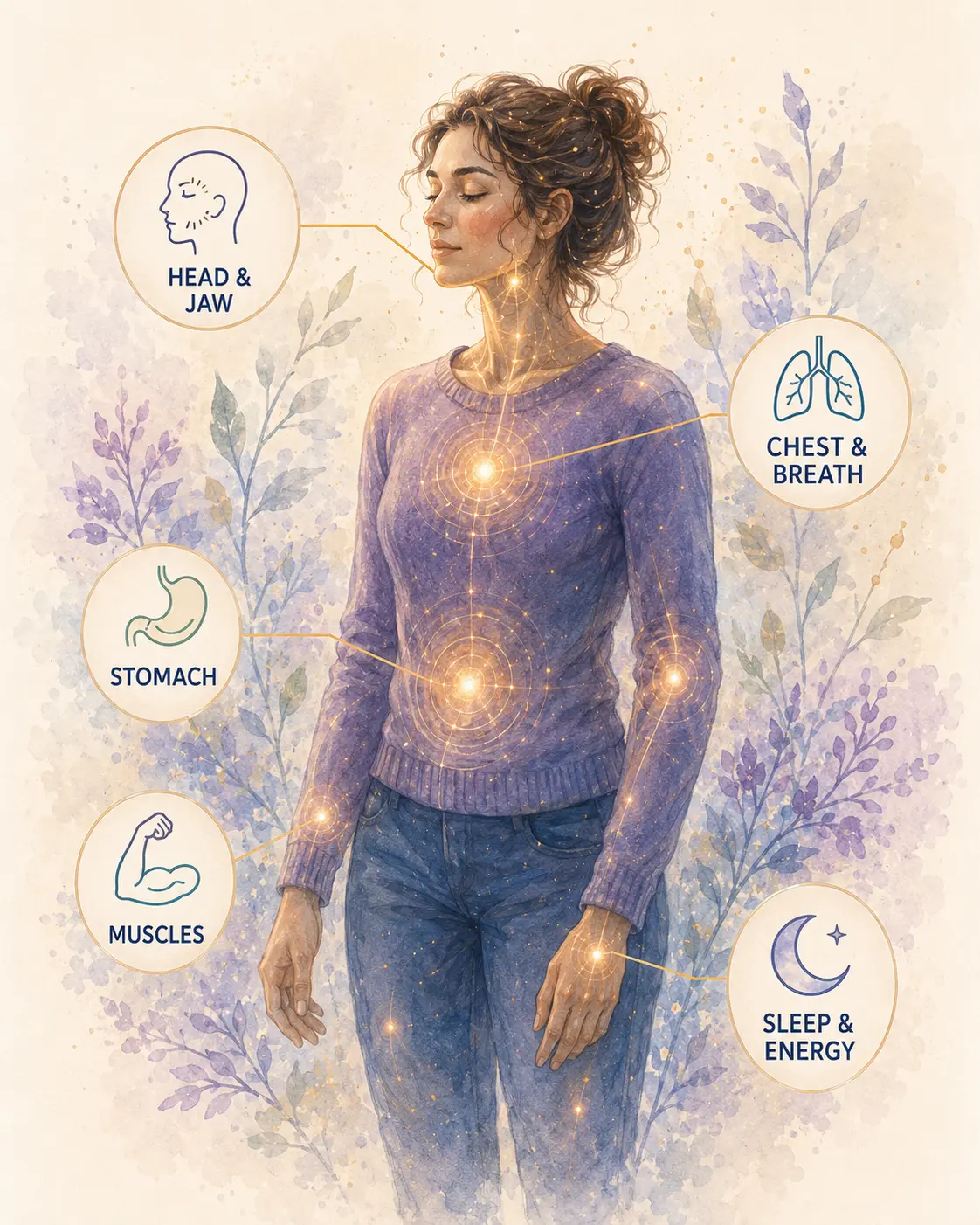
Stress can show up in more than one place.
You do not need to experience every sign. Your own pattern may be quite specific.
Holding tension above the shoulders
You may notice headaches, jaw clenching, facial tension or feeling mentally overloaded.
Bracing without realising
Stress may be accompanied by muscle tension, pain or a sense that your body is continually holding itself ready. :contentReference[oaicite:2]{index=2}
Feeling activated internally
Stress may be associated with a faster heartbeat or chest sensations. :contentReference[oaicite:3]{index=3}
Breathing can change with activation
You may notice that your breathing becomes quicker, shallower or harder to ignore when you feel stressed or alarmed.
The gut may respond too
Stress can be accompanied by stomach problems, digestive discomfort or changes in appetite. :contentReference[oaicite:4]{index=4}
Stress can follow you into recovery time
Trouble sleeping and feeling tired can accompany stress, particularly when your mind or body has difficulty settling. :contentReference[oaicite:5]{index=5}
What is your body doing right now?
Do not try to relax yet. First, simply notice what is already happening.
Select any signals you recognise.
Ask what the signal might be asking for.
Not every sensation needs an elaborate intervention. Sometimes the useful response is very ordinary.
Noise, screens, conversation or activity may need to reduce.
Your body may need walking, stretching or a change of position.
Basic physical needs can easily become tangled with stress.
Your system may need recovery rather than another productivity technique.
The pressure may be coming from something that actually needs to stop or change.
A physical symptom may need assessment rather than being interpreted through stress alone.

Signal → Need → Response
Instead of immediately trying to eliminate a sensation, see whether it contains useful information.
What do I notice?
Tight jaw. Fast thoughts. Restlessness. Heavy body. Upset stomach. Fatigue.
What might help?
Space. Movement. Food. Rest. Quiet. Reassurance. A boundary. Medical advice.
What can I do now?
Choose one small action that fits the actual need rather than doing everything at once.
Do not automatically assume a physical symptom is stress.
Stress can be associated with physical symptoms, but similar symptoms can also have medical causes. If something is new, severe, persistent, worsening or simply concerns you, seek appropriate medical advice.
Regulation tools can support wellbeing. They do not replace medical assessment.
What would help next?
Your body does not need to shout before you listen.
Notice the signal early and respond with the smallest useful support.